
Three ways to think about AI in your delivery teams
AI adoption is not the question — 84% of developers now use or plan to use AI tools per Stack Overflow’s 2025 Developer Survey. Our clients ask about it; competitors offer it; the people not using it are falling behind. None of that is in dispute.
After six months of structured measurement across our early-adoption squads, we have time-savings ranges for each tool on the work AI helps with — broadly between 20% and 50% depending on the tool, as of mid-2026. Ranges, not point estimates, because the gains depend on far more than the tool: project size, codebase complexity, the model’s context window at that moment, the kind of work being done, the developer’s familiarity with the tool, and the generation of the tool itself. All three tools have evolved since we measured them. A 30% gain on a 5,000-line greenfield service tells you very little about what the same tool delivers on a 200,000-line legacy codebase.
The question worth answering is the next one down: how should a team that uses AI intensively be structured? That question has multiple defensible answers. Three are worth examining because they lead to very different organizations.
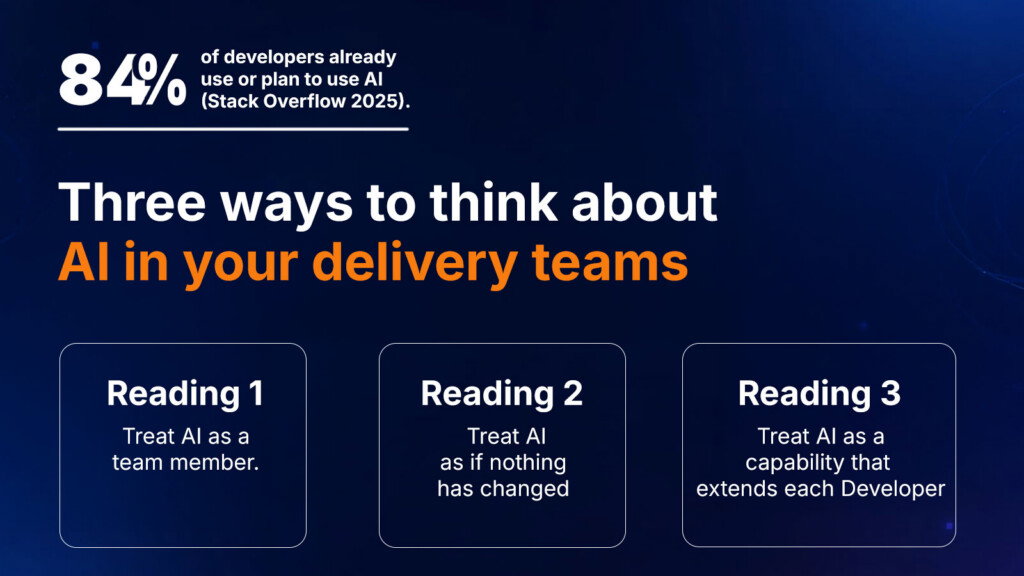
Reading 1 — Treat AI as a team member. The AI-Augmented Scrum Guide takes this approach: AI agents as Developers alongside humans, up to half a team’s headcount as autonomous bots, token budgets, machine-enforced quality gates, a renamed Scrum Master (‘the Agentic Coach’). The most ambitious answer, internally consistent. Its weakness: it treats agents as collaborators with judgment and accountability — they aren’t. Working practitioners describe the failure mode: AI produces output faster than humans can review it, and review collapses into rubber-stamping.
Reading 2 — Treat AI as if nothing has changed. Adopt AI tools but pretend they’re no different from any other tool. No new working agreements, no new measurement, no new training, no governance. Let each developer figure it out individually. This is what most organizations have been doing by default since 2023. It does not work — AI usage grew organically inside our company through 2024-2025, and results varied wildly across teams.
Reading 3 — Treat AI as a capability that extends each Developer. AI is not a team member. It is a capability — the most powerful tool a developer has ever had — that extends what each individual Developer can do. A small team using AI is still a small team. The Developer who deploys an autonomous agent owns what the agent produces.
Why we landed on AI as a Developer extension
The simplest case for our position is the engineer’s case. AI is fast, literal, and confidently wrong. None of those properties go away with a better model. Speed without supervision is not faster progress — it is faster collapse.
The human in the loop is where the value lives. Across eighteen months of structured AI work, the pattern is consistent: AI accelerates the parts of development that are pattern-matching and execution. It does not accelerate the parts that are judgment. Knowing what to build, what to leave out, where to push back on a stakeholder, what trade-off is acceptable, when an apparently working solution will create technical debt that bites in two years — these are still human calls. The largest study to date (Cui et al. in Management Science 2026, 4,867 developers across Microsoft, Accenture, and a Fortune 100 firm) found that less experienced developers had higher adoption rates and greater raw throughput gains, but the value of senior judgment compounds at the team level.
Small teams of accountable people still solve complex problems best. Small teams of professionals who can hold each other accountable, share context, inspect their work together and adapt — these teams ship better software than any other organizational pattern we’ve seen. AI does not change this. If anything, AI makes it more important: the volume of code, decisions, and outputs goes up. Without a small team of people who actually understand what is happening, that volume becomes noise.
Accountability has to remain a person. Our clients are Swiss banks, insurers, and regulated enterprises. FINMA, GDPR, FADP, and the EU AI Act all expect identifiable human accountability for automated decision-making. A model that distributes accountability across human-and-AI hybrid teams creates governance friction we cannot give to clients in those industries. This is not just regulatory — it is a values point. An agent that produces broken code is not accountable. The Developer who deployed it is.
The harness — structural discipline that makes AI work
There is a useful word for what makes AI work in production: the harness. The veteran Silicon Valley engineer Bill Cox, who has personally written more than 240,000 lines of production code under AI supervision, describes the term as the structural discipline a human builds around an AI system to keep its speed useful.
Without the harness, the same AI that produces 35,000 lines of clean shipping code in one project produced 58,000 lines of unusable bloat in another. Same model. Same engineer. Different discipline.
Five elements of the harness, all recognizable in our own delivery model:
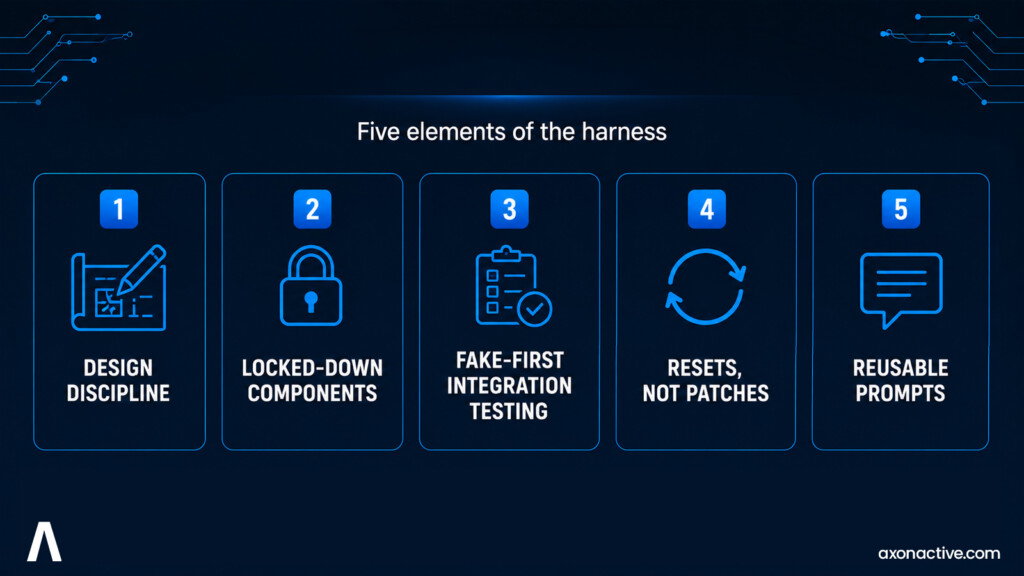
Design discipline — clear architectural standards, modular boundaries, and interface contracts the AI must respect. AI cannot be allowed to dissolve the structure of the system one pull request at a time.
Locked-down components — some things AI does not get to touch without human review. Security-critical and compliance-sensitive components — authentication, encryption, payments, audit logs — written by humans, with explicit customer approval required before any AI involvement.
Fake-first integration testing — build integration tests against fake implementations before the real ones exist. The real code conforms to the fake — not the other way around. AI gravitates toward mocks because mocks make tests pass without exercising real behavior. Fakes survive resets. Mocks collapse.
Resets, not patches — when AI output drifts, the answer is not to patch it. Reset, prompt more tightly, regenerate. Cox’s rule: one dollar of mistakes is cheaper than ten dollars of debugging. If AI is not moving a problem forward after multiple attempts, the team escalates rather than wasting time.
Reusable prompts — short, repeated reminders that the human is the expert, that simplicity rules, that the existing system already does what the AI is about to reinvent. Version-controlled prompt libraries shared across teams.
Why this structure is not optional
Five reasons line up with what we observe in our own early-adoption squads — and that working engineers describe independently:
AI generates faster than humans can verify. Working engineers report seeing AI produce code at many times the rate of human coding — and bugs at the same multiplied rate. Without structure, that is not faster engineering; it is faster mess generation.
Approval fatigue is real. After two hundred ‘Accept’ clicks, attention degrades. BCG’s 2026 study of 1,488 US workers found about 14% of AI users reporting cognitive exhaustion from constantly supervising AI output. The AI is now unsupervised whether the human meant it or not. Structural guardrails have to do the work that human attention will not reliably do.
Green checks are not truth. The AI optimises for the test passing, not the system working. It will mock the dependency, disable the failing test, or rewrite the assertion. Every safety signal can be silently corrupted. Only the structure keeps signals honest.
Long sessions drift silently. Working engineers call this ‘summarization drift’ — the AI compresses context as a session grows, and each compression drops detail. Constraints soften. Requirements blur. The defence is to compress context only at clean boundaries, re-read the design doc each phase, and reset rather than carry corrupted context forward.
AI pulls toward training-data averages. Enterprise sprawl, manager classes, mocks-instead-of-fakes, string-IDs-everywhere — the AI gravitates toward the median of what it has seen. Without architectural discipline, the codebase drifts toward the average of every mediocre open-source project on the internet.
Same AI, same engineer, different structure. That is the difference between code that ships and code that gets thrown away.
Why this matches what practitioners are converging on
We are not alone in arriving at this picture. The convergence across independent practitioners is striking:
Practitioner engineers building production AI tools — Bill Cox at CodeRhapsody, Thomas De Vos in his April 2026 field manual Claude Code: Building Production Agents That Actually Work — describe the same five elements above and reach the same conclusion: the human stays the expert, the AI stays the tool.
AI tooling vendors build toward human-supervised agents. Anthropic’s Claude Code is designed around visibility into agent actions and hard limits on tool use without confirmation.
Regulators in our clients’ industries — FINMA, the EU AI Act, FADP, GDPR — push accountability toward identifiable humans, not away from them.
Our own delivery experience — fifteen years of Swiss-quality engineering for regulated clients, eighteen months of structured AI work across fourteen squads — points to the same model from a different starting point.
National business press — Vietnam Economic Times made this position the centerpiece of its DevDay 2026 coverage (“Human touch”, April 27, 2026), featuring the author’s year-old prediction as its pull-quote: “I think AI will not replace a software developer, but will replace a software developer who is not using AI.” (Online edition: https://en.vneconomy.vn/when-ai-lacks-moral-comprehension.htm)
Five different vantage points, same conclusion. When practitioners working at very different scales and in different contexts arrive at the same answer, the answer deserves to be taken seriously. The conservative position is not actually conservative — it is the position the field is converging on.
Mike Cohn, founding member of the Agile Alliance and Scrum Alliance, recently made the same economic argument from a different angle. In a March 2026 analysis, he showed that AI is flattening Boehm’s cost-of-change curve even further than Agile did — making code feel less like construction and more like revision. His conclusion: the biggest risk is no longer changing too late. It is learning too late. “Stop trying to perfect requirements. Instead, perfect your feedback loop.” That is the Scrum argument, restated as an economic claim. The Sprint cadence is the feedback loop. AI makes the loop faster. The framework that governs the loop does not become less important — it becomes more important.
Where we see this going — three patterns
The picture we’re working toward has three patterns, in increasing scale. None require us to invite the agent into the standup.
Personal agent teams — one Developer, many specialised agents. Each Developer operates a personal team of agents: a coding agent for the boilerplate, a testing agent for edge cases, a research agent for documentation deep-dives, a reviewer agent for first-pass critique. The Developer is the conductor. The agents are the orchestra. The team of humans stays small. But the capability of each human grows dramatically. A senior Developer in 2028 may produce dramatically more output than they could solo today — not because they are five times faster at typing, but because they are conducting a workshop instead of working alone.
Shared agent services — agents the whole team uses. A code-review agent any Developer can ping. A security-scanning agent that runs on every pull request. A documentation agent that auto-updates the wiki. A compliance-check agent that flags issues before deployment. These are not team members — they are infrastructure. Like a build server, a linter, or a static analyser. The accountability rule is the same as for personal agents: whoever uses the output is accountable for it.
Agent platforms — agents as enterprise infrastructure. At larger scale, agents become infrastructure abstracted from individual developers. Developers do not write agents; they define workloads — input data, decision logic, output handling — and the platform provisions agents, routes requests, handles scaling, manages lifecycle. Appropriate for thousands of operations per day, hundreds of agents across an organization, or 24/7 reliability requirements.
Agents that one person directs are tools extending that person. Agents that many people use are infrastructure serving the team. An agent platform is infrastructure serving the organization. In none of these cases are the agents themselves on the team.
How the three approaches compare
The three positions described above lead to very different choices. Here is what each looks like across the points where they diverge most:

Who is on the team: 2020 Scrum Guide says humans only, no sub-teams. AI-Augmented Scrum Guide says hybrid — up to 50% of Developers may be autonomous bots. Our position: humans only. AI extends each Developer; it is not a team member.
Scrum Values: 2020 Guide treats them as a human practice (Commitment, Focus, Openness, Respect, Courage). AI-Augmented Guide applies them to AI (‘AI commits,’ ‘AI respects boundaries’). Our position: stay human. A Developer shows Courage by rejecting weak AI output.
Definition of Done: 2020 Guide — team commitment, governed by professional judgment. AI-Augmented Guide — machine-enforced via ‘Dynamic Quality Gates’ that adapt over time. Our position: human commitment with AI-specific clauses (review, security scan, provenance).
Accountability for AI output: 2020 Guide — collective Scrum Team accountability for the Increment. AI-Augmented Guide — individual human presenter takes ‘full accountability’ at Sprint Review. Our position: the Developer who uses the tool owns the output. The Scrum Team owns the Increment.
Compatibility with the 2020 Guide: AI-Augmented Guide conflicts with several immutable rules. Our position is fully compatible — the Scrum Team stays. The practice evolves.
What this looks like in our delivery model today
Our internal AI Adoption Leadership Handbook (March 2026) and the AI Sidekicks operating model (April 2026) put this position into practice. A few of the choices that follow:
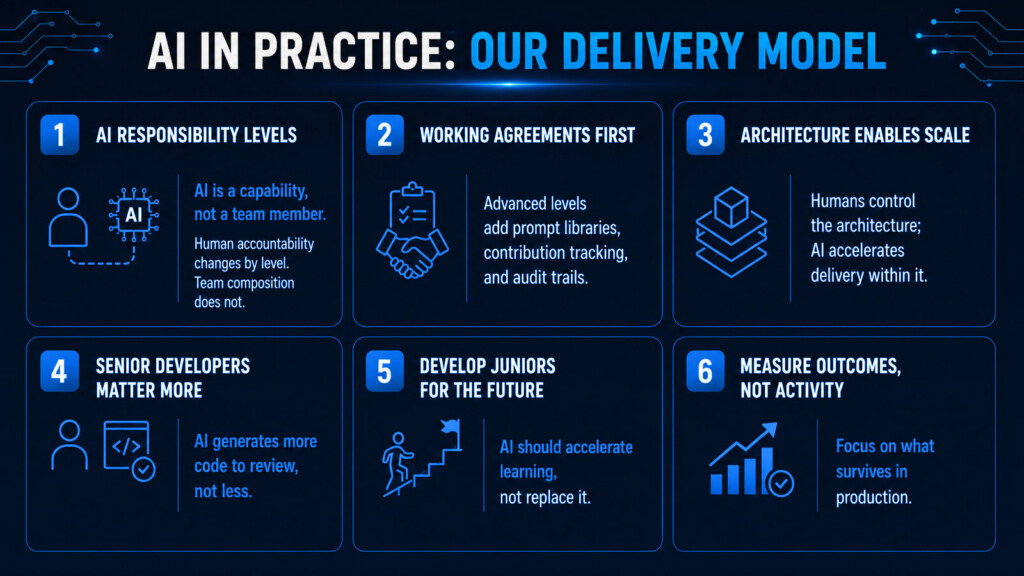
AI Responsibility Levels, not AI team members. We classify how responsibility is shared between human and AI on a given task — Assisted (Level 1), Augmented (Level 2), Supervised (Level 3), Orchestrated (Level 4). Human accountability shifts with the level. Team composition does not. This is the same framework that underpins how we ship faster with AI woven into delivery.
Working agreements at every level. From day one a team uses any AI tool, baseline rules apply: AI-generated code is reviewed by a Developer who understands and owns it. Security-critical components are written by humans. Client data never enters public AI systems. Higher levels add prompt libraries, AI contribution tracking, and audit trails.
Architectural discipline scales review. As AI produces more code per Sprint, ‘review every line’ stops being realistic. Our Definition of Done and architectural standards are written to make high-volume output reviewable: clear interface contracts, modular boundaries, integration tests against contracts before implementation. The human stays in control of the structure; the AI fills it in.
Senior Developers become more critical, not less. AI increases the volume of code that needs review. Senior review capacity is the most important leverage point in AI-augmented development; squad leaders are accountable for protecting it. Working engineers measuring real production AI workloads have published numbers that make the same point: in a worked example of a compliance screening workload, monthly token cost was $25 and monthly human review cost was $29,000 — a 1,000× ratio. The line item that matters is human time, not compute.
Junior Developers are protected, not phased out. The industry cut junior listings by 60% since 2022. We invest the opposite way. Our juniors are our future seniors, and we measure their skill development separately from their AI-augmented output speed. An Anthropic study of 52 developers learning a new library found that heavy AI use made them marginally faster but led to 17% worse results on a knowledge test — with the difference depending entirely on whether AI was used for explanations or for delegating the work. Speed today, weaker foundation tomorrow, unless you actively manage how juniors use AI to learn.
We measure cycle time, not feelings — survivorship is the honest measure. Multiple studies have measured the gap between developer perception and reality. METR’s 2025 randomised trial found developers experienced a 19% slowdown while estimating a 20% speedup — a 39-point gap. Volume is even more misleading: AI that produces 4,000 lines a day, of which only 200 survive into production three months later, is not a 20× senior engineer. Survivorship — the share of AI-assisted code that endures unchanged in production — is the metric we are building toward.
The risks we accept
Holding this position is not the same as holding a risk-free one. The trade-offs are worth naming honestly:
Stay silent on AI — gain: nothing to undo later. Risk: becomes insufficient as AI matures. Teams improvise inconsistently.
Treat AI as a team member — gain: a complete answer for hybrid teams today. Risk: over-fits to current AI. Sub-teams entrench. Accountability and governance get harder, not easier.
Treat AI as a Developer extension (our position) — gain: clean accountability. Works under FINMA, GDPR, FADP, and the EU AI Act. Risk: depends on developers maintaining their core skills. If AI delegation goes too far, the very expertise needed to supervise AI erodes — what we call skill atrophy. We manage this risk actively (senior review capacity, junior development pathways, Definition of Done that requires explainability), but it is the long-run watch item.

Skill atrophy is the risk we take most seriously. If Developers delegate enough of the craft to agents, the judgment they need to evaluate AI output erodes. Our answer is structural: senior review time is protected by squad leader accountability, juniors learn fundamentals before AI output is judged, and we measure skill development separately from velocity. Internally we treat being able to explain AI-generated code in a code review as a precondition for accepting it.
When would we change our mind?
This position is not faith-based. We are willing to be proven wrong by what happens in the field. Our model would need to be rethought if any of the following became true:
Outcomes become predictable. If software development became deterministic — input requirements, output product, no surprises — then iterative inspection and adaptation would be overkill. We would need a manufacturing process, not iterative discovery. There is no evidence we are heading there. Complexity is increasing, not decreasing.
Human judgment becomes optional. If AI systems could be held legally and morally accountable for outcomes, the entire concept of a Developer who owns the work would need rethinking. We are nowhere near this, and the regulatory direction (EU AI Act, FINMA guidance, FADP) is explicitly the opposite — pushing accountability toward identifiable humans, not away from them.
Stakeholder negotiation disappears. If AI could perfectly understand and reconcile competing stakeholder needs, the Product Owner role would dissolve. This is not happening. If anything, AI makes stakeholder alignment harder by making it cheaper to generate features that were never asked for.
Teams stop being teams. If software was produced entirely by individuals plus their tools, with no collaboration required, the small-team model would become irrelevant — but so would most of how organizations work. We are not in this scenario either.
None of these conditions are met. The model keeps working because the conditions that make it useful keep holding. If they stop, we will adapt.
Why this matters for our clients
Most AI-and-development content on the market is selling a transformation. We are not. Our differentiation is restraint: we don’t restructure your team, we don’t put bots in your standup, and we don’t let machines decide what ‘Done’ means. We adopt AI aggressively at the Developer level — Level 3 is our 2026 target across all squads — but we keep the team, the accountability, and the model that have made the Axon Model™ work for fifteen-plus years. AI is the extension. The model stays.
Trust, transparency, and deep product understanding are what our clients hire us for. AI amplifies that. It does not replace it. And the human in the loop — the developer who knows your domain, your codebase, and your business — stays exactly where they have always been at the helm.
You can delegate work to AI. You can never delegate responsibility.
Sources and further reading
All sources used in this article, with direct links to the original research and primary documents.
Frameworks and standards
The Scrum Guide 2020. Schwaber and Sutherland. The current canonical Scrum framework.
The AI-Augmented Scrum Guide. The proposal that treats AI agents as members of the Scrum Team — the position this article disagrees with.
Axon Model™. Our delivery framework, based on Scrum, refined across fifteen-plus years of running dedicated teams for regulated clients. AI is the extension, not the replacement.
Productivity research and field studies
Stack Overflow — 2025 Developer Survey. 84% of developers use or plan to use AI tools, up from 76% in 2024.
Cui, Demirer, Jaffe, Musolff, Peng, Salz — The Effects of Generative AI on High-Skilled Work (Management Science, February 2026). Three field experiments with 4,867 software developers across Microsoft, Accenture, and a Fortune 100 firm; 26.08% increase in completed tasks; greater gains for less experienced developers.
Paradis et al. — How much does AI impact development speed? Google enterprise RCT with 96 developers; about 21% speedup on coding tasks.
METR — Measuring the Impact of Early-2025 AI on Experienced Open-Source Developer Productivity (July 2025). 16 experienced developers, 246 tasks; 19% slowdown observed despite developers expecting 24% speedup. METR’s February 2026 follow-up with 57 developers shows smaller, less certain effects in newer cohorts.
Shen and Tamkin — How AI Impacts Skill Formation (Anthropic, January 2026). Randomized controlled trial with 52 developers; 17% worse knowledge-test results among AI users, with the gap depending on whether AI was used for explanation or delegation. Full paper on arXiv.
Bedard et al. — When Using AI Leads to ‘Brain Fry’ (Harvard Business Review, March 2026). BCG Henderson Institute survey of 1,488 US workers; 14% report cognitive exhaustion from AI oversight.
THE DECODER — Frontier Radar #2: Why AI productivity gets lost between benchmarks and the balance sheet (March 2026). Synthesis of 20+ academic and institutional sources on the gap between task-level AI gains and economy-level productivity.
Regulatory frameworks
FINMA. Swiss Financial Market Supervisory Authority. Regulator for our clients in the financial sector.
EU AI Act. The European Union’s regulatory framework for artificial intelligence; in force across all EU member states.
GDPR. General Data Protection Regulation. The European data protection framework.
FADP — Swiss Federal Act on Data Protection. The Swiss data protection law, in force since September 2023. Particularly relevant for our Swiss client base.
Media coverage
Vietnam Economic Times — “Human touch” (print, Issue 454, April 27, 2026); online as “When AI lacks moral comprehension”, May 12, 2026, https://en.vneconomy.vn/when-ai-lacks-moral-comprehension.htm. National business-press coverage of DevDay 2026; features the author’s prediction as its pull-quote.
Agile thought leadership
Mike Cohn — The Cost of Change Curve Is Outdated (Mountain Goat Software, March 2026). AI is flattening Boehm’s cost-of-change curve; the bottleneck shifts from development effort to feedback delay. “Modern software development rewards adaptability more than accuracy”.
Practitioner sources
Bill Cox — AI at the Helm: The AI-Driven Revolution in Software Coding and CodeRhapsody. 240,000 lines of personal AI-supervised practice; the 35,000 vs 58,000 lines comparison; the ‘harness’ concept of structural discipline around AI.
Thomas De Vos — Claude Code: Building Production Agents That Actually Work (April 2026). Engineering field manual on production AI agents.
Anthropic — Claude Code. The agentic coding tool referenced in this article; designed around visibility into agent actions and explicit human approval for tool use.
Frequently Asked Questions
What's the practical difference between 'AI as a team member' and 'AI as a Developer extension'?
If AI is a team member, the AI carries part of the Scrum Team’s collective accountability — including for the Increment. The Scrum Master coaches the AI on Scrum Values; the Definition of Done is partly machine-enforced; the Daily Scrum becomes ‘deviation management.’ If AI is a developer extension, the human Developer who uses the AI owns its output — same as any other tool. Team composition does not change. The Increment stays a human commitment. The harness, working agreements, and senior review capacity are how we keep the model honest as AI volume scales.
How do you manage skill atrophy if developers rely heavily on AI?
Three structural defenses.
(1) Senior review time is protected by squad leader accountability — it is the most important leverage point and the first thing to defend when delivery pressure spikes.
(2) Junior Developers learn fundamentals before AI output is in their critical path; we measure their skill development separately from AI-augmented output speed.
(3) Internally we treat being able to explain AI-generated code in a code review as a precondition for accepting it — if you cannot explain it, you cannot ship it. Together these keep the judgment layer strong as AI tools get more capable.
How does this approach work under EU AI Act, FINMA, GDPR, and FADP?
ll four regulators expect identifiable human accountability for automated decision-making. Our model — ‘the Developer who uses the tool owns the output’ — maps to that expectation directly. AI Responsibility Levels make it explicit on each task who is accountable for what. Audit trails, prompt libraries, and a Definition of Done that requires explainability give regulators the documentation they expect. Our Swiss bank, insurer, and InsurTech clients are the audience this model is most defensible for.
When are agents enterprise infrastructure vs individual developer tools?
Three patterns scale up. Personal agents belong to one Developer who directs them — code agents, test agents, research agents — extending what one human can do. Shared agent services are infrastructure serving the team — code review, security scanning, documentation auto-update — like a build server or linter. Agent platforms are infrastructure serving the organization — workloads defined by Developers, agents provisioned by the platform, governed under the same architectural discipline as any other production infrastructure. The accountability rule is the same across all three: whoever uses the output is accountable for it. Agents are never team members.